
Automated merchant review summary system with integrated feedback
Introduction
Merchant reviews contain useful details about food quality, portion size, packaging, and value. Finding these details often requires reading many comments. Aggregate ratings simplify comparisons, but they do not explain what shaped each score.
We built the Automated Merchant Review Summary System to turn written reviews into concise summaries. Consumers can scan an overall summary or focus on a specific topic. Merchants can identify what customers value and which parts of the experience need attention.
This article focuses on how we generate and maintain consumer-facing review summaries. A misleading or incomplete summary can affect how consumers view a merchant. Merchant-facing recourse and dispute processes sit outside this pipeline and are not covered in this process flow.
Problem statement
A long, unstructured list of reviews creates two related problems. Consumers spend time searching for comments that match their priorities, while merchants must combine individual comments to identify recurring themes.
Consumers may see hundreds or thousands of reviews for a merchant. Reading only the first few can produce an incomplete picture, while the aggregate star rating provides little context. Two restaurants with the same rating may differ in food quality, delivery experience, portion size, or value.
Merchants face a related problem. Reading and classifying every review takes time, and the task becomes harder as review volume grows. Recurring complaints and positive patterns can remain hidden among individual comments.
Existing approaches
Manual review analysis
Consumers and merchants can read reviews one by one and form their own conclusions. Their conclusions depend on which reviews they read and how they interpret them. This method becomes impractical as review volume grows.
Aggregate star ratings
An average score quickly indicates customer opinion but does not explain the reasons behind it. A merchant can see overall performance but not the themes that may require attention.
Keyword search and filtering
Keyword search helps readers who already know what to look for. It does not reveal unexpected themes, and literal matching may separate phrases with the same meaning. For example, “too cold”, “not warm enough”, and “lukewarm” all describe a food-temperature issue.
Our solution
The system uses representative sampling, large language model (LLM) summarisation, automated quality checks, and consumer feedback. It generates an overall summary and topic-based summaries for areas such as taste, packaging, and portion size.
The pipeline has three flows:
- Summary generation and validation: The pipeline samples reviews, generates overall and topic-based summaries, and checks whether the source reviews support each claim.
- Summary maintenance: The system monitors new reviews and consumer feedback, then regenerates a summary when either reaches a configured threshold.
- Summary display and feedback: The interface retrieves a validated summary for the merchant’s review page and records whether consumers found it helpful.
Architecture
The generation pipeline prepares the source reviews, produces summaries, and validates the output before publication.
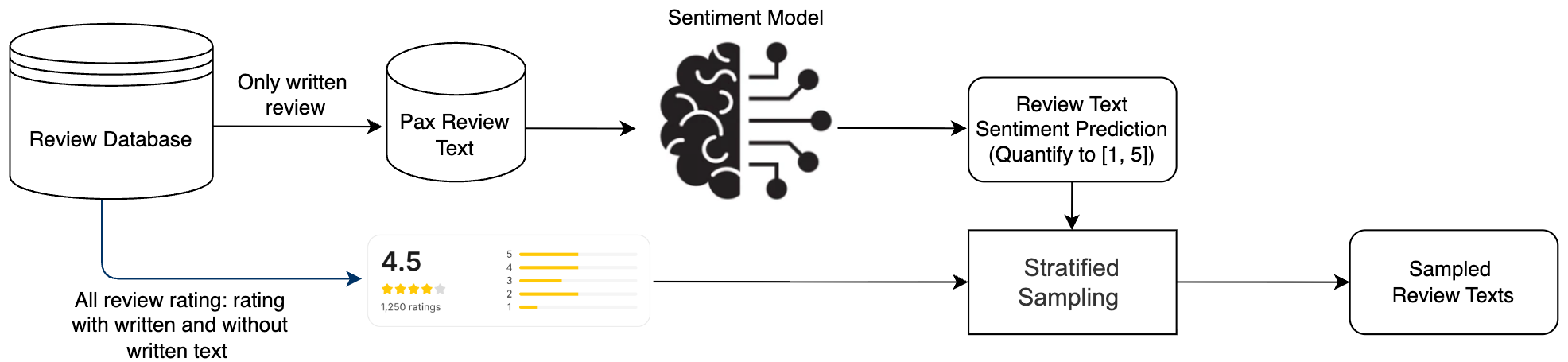
Data preparation and representative sampling: The pipeline calculates the merchant’s rating distribution. A sentiment model assigns each written review a score from one to five. Stratified sampling then selects a smaller set of reviews that follows this distribution, reducing the chance that one rating group dominates the summary. However, matching the rating distribution does not guarantee that the sample represents every period, language, customer segment, or aspect of the merchant experience.
Summary generation with an LLM: The system sends the sampled reviews to an LLM with instructions to produce:
- A concise summary of the sampled reviews.
- Topic-based summaries for categories such as taste, packaging, and portion size.
The system can update the topic set when new themes appear in consumer feedback.
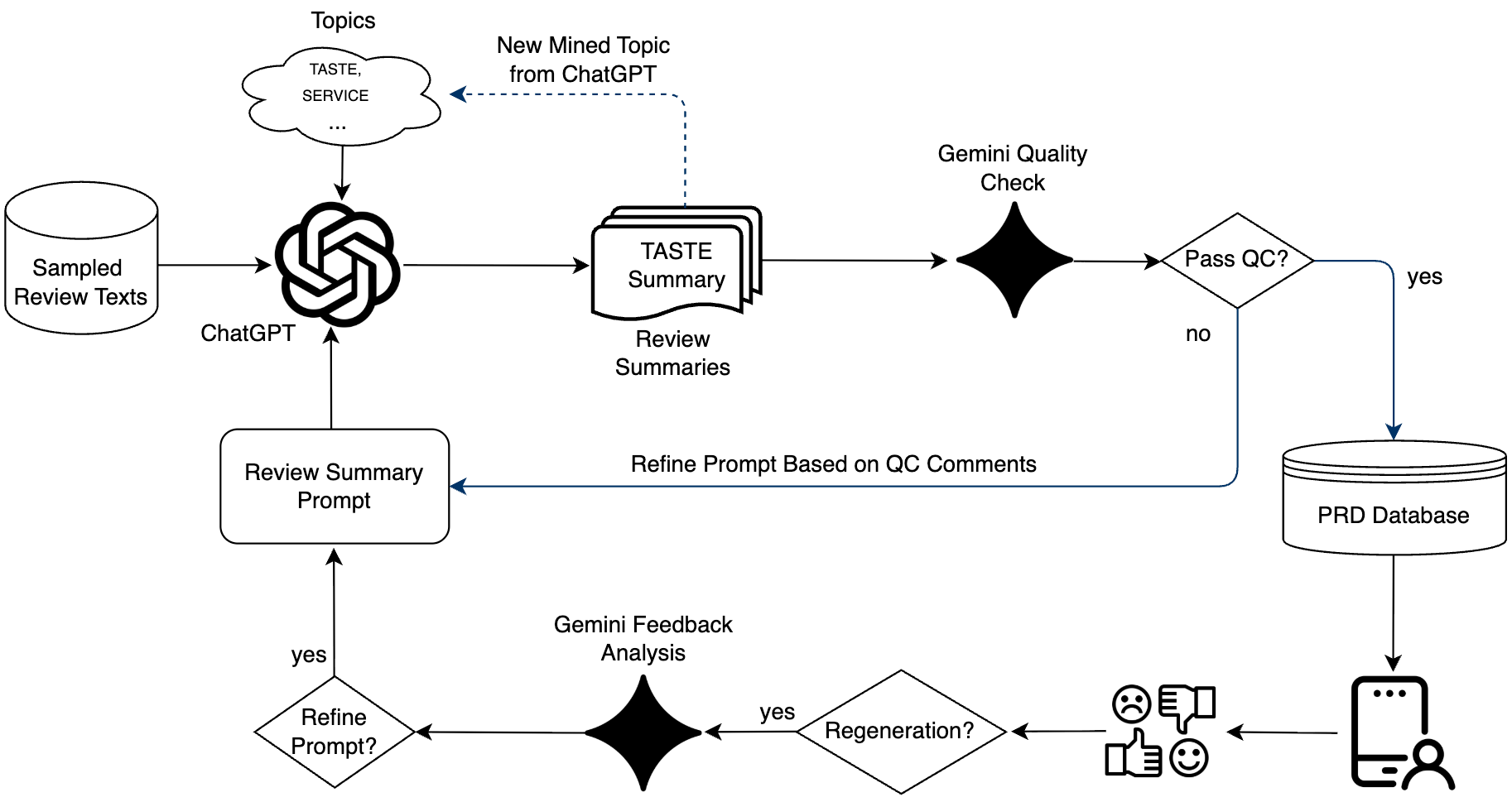
Quality control (QC) with an LLM: A separate LLM receives the generated summary and the sampled reviews. Summaries that do not meet the validation criteria are withheld from publication. Passing this automated assessment reduces, but does not eliminate, the risk of unsupported claims. The maintenance flow updates stored summaries in response to incoming reviews and consumer feedback:
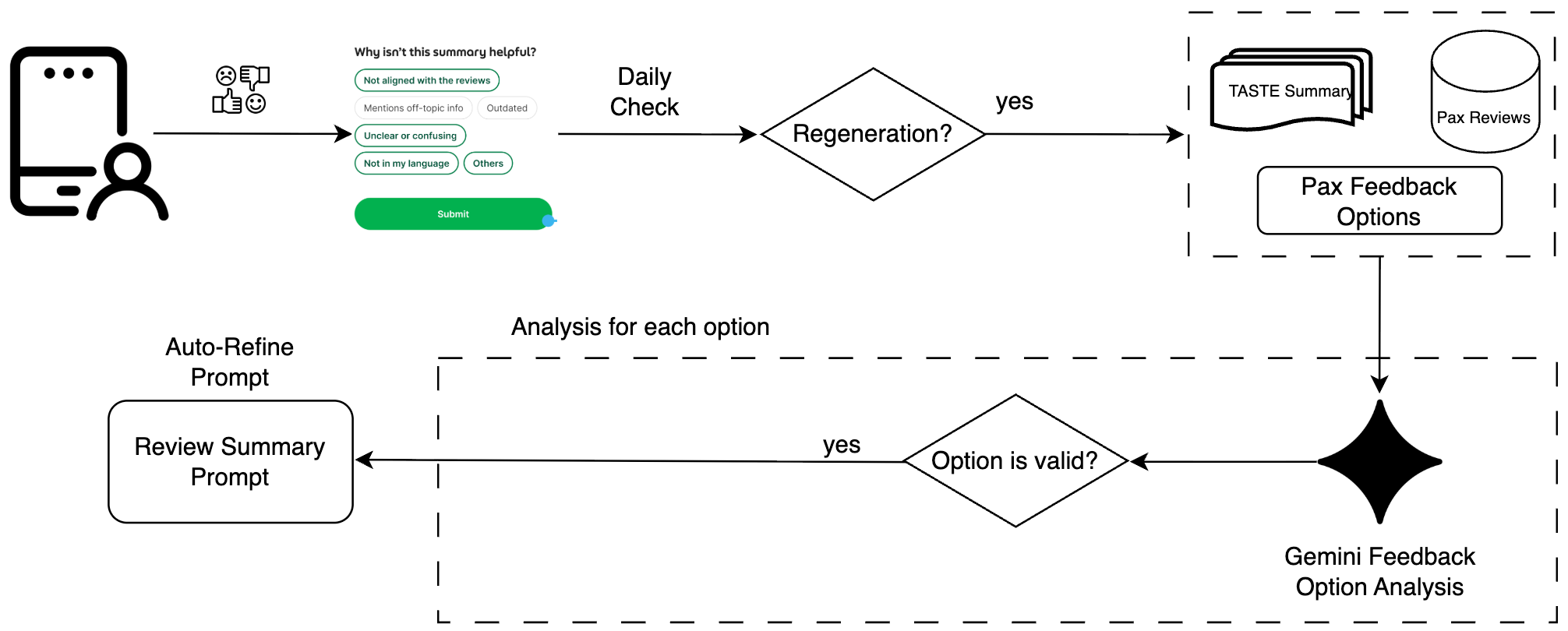
- New-review trigger: A monitoring service counts reviews submitted after the latest summary. When the count reaches a configured threshold, the service starts the generation and validation flow.
- Consumer-feedback trigger: The interface records whether consumers found a summary helpful. When negative feedback reaches a configured threshold, the system generates and validates a new summary.
Impact
Review summaries are designed to reduce the amount of text consumers need to scan. Topic-based summaries can surface themes that are not visible in an aggregate rating alone. The quality-control step rejects unsupported claims. The regeneration triggers incorporate new reviews and consumer feedback into later summaries.
Learnings and conclusion
Useful review summaries depend on more than generation quality. The source sample must reflect the intended population, each claim must remain grounded in source reviews, and the output must change with the underlying feedback. Automated LLM validation is one layer of defence, not sole proof of accuracy, and feedback-driven regeneration needs anti-abuse controls to remain trustworthy.
Representative sampling, separate generation and validation stages, and feedback-based regeneration form a practical system for maintaining consumer-facing merchant review summaries. This article describes that technical pipeline; it does not cover the full set of merchant recourse options when a summary is disputed.
Join us
Grab is Southeast Asia’s leading superapp, serving over 900 cities across eight countries (Cambodia, Indonesia, Malaysia, Myanmar, the Philippines, Singapore, Thailand, and Vietnam). Through a single platform, millions of users access mobility, delivery, and digital financial services, including ride-hailing, food delivery, payments, lending, and digital banking via GXS Bank and GXBank. Founded in 2012, Grab’s mission is to drive Southeast Asia forward by creating economic empowerment for everyone while delivering sustainable financial performance and positive social impact.
Powered by technology and driven by heart, our mission is to drive Southeast Asia forward by creating economic empowerment for everyone. If this mission speaks to you, join our team today!